Milan · Brera · Mantegna, Raphael, Caravaggio, Hayez
Pinacoteca di Brera: tickets, hours and masterpieces
Milan’s great picture gallery, inside Palazzo Brera. Opening hours, the booking rule, evening openings and the rooms of the best-known paintings, read on 24 October 2026.
Today
Opening hours for every month are on the Opening hours page.
Checked against the official website on 24 October 2026 · Official source
In short
- The Pinacoteca di Brera is open Tuesday to Sunday from 8:30 to 19:15, with the last entry at 18:00, and closed on Mondays, 1 May, 25 December and 1 January, according to the museum’s site read on 24 October 2026. A reservation with date and time is always required for La Grande Brera, including for the free first Sunday of the month.
- La Grande Brera also opens Palazzo Citterio on the day of the visit and the 6 days after. Entry is free under 18 and reduced for ages 18 to 25. On Thursdays up to 17 December 2026 the gallery opens until 23:20 (last entry 22:00), with a special evening ticket from 18:00, according to the museum’s site.
- The museum’s room cards place Mantegna’s Dead Christ in room VI, Raphael’s Marriage of the Virgin and Piero della Francesca’s altarpiece in room XXIV, Caravaggio’s Supper at Emmaus in room XXVIII and Hayez’s The Kiss in room XXXVIII. Rooms can change.
- The guided tour of Brera on this site is a 2-hour walk in a small group with a live guide, which takes in the Pinacoteca and the Brera district, entry ticket included.
Mantegna, Piero della Francesca and Raphael
Mantegna’s Dead Christ (about 1483, tempera on canvas, 68 × 81 cm) is in room VI. The museum says the most accepted theory identifies it with the “Cristo in scurto” found in Mantegna’s studio when he died; it reached the Pinacoteca in 1824, in a purchase mediated by Canova.
Piero della Francesca’s altarpiece (1472–1474, tempera on panel, 251 × 172 cm), in room XXIV, shows the Virgin and Child with saints, angels and Federico da Montefeltro. The museum calls it the Pala di San Bernardino; other pages name it the Pala Montefeltro. It came from the church of San Bernardino in Urbino after the Napoleonic suppressions, and its format was reduced. Baedeker’s 1903 handbook is still unsure of the attribution and adds “or Fra Carnavale?”.
Raphael’s Marriage of the Virgin (1504, oil on panel, 170 × 118 cm), also in room XXIV, is signed “RAPHAEL URBINAS / MDIIII”. It was painted for the church of San Francesco in Città di Castello, where Baedeker says it stayed until 1798, and reached Brera in 1805, according to the museum. Reflectography shows perspective lines converging on the door of the temple.
Caravaggio, Hayez and the rest
Caravaggio’s Supper at Emmaus (1606, oil on canvas, 141 × 175 cm) is in room XXVIII. The museum says it was probably at Paliano with the Colonna family after the painter’s condemnation, and that it was still in the Patrizi family’s Roman palace in 1939, when the Associazione Amici di Brera bought it for the Pinacoteca.
Hayez’s The Kiss (1859, oil on canvas, 112 × 88 cm) is in room XXXVIII. It was shown at the Brera exhibition of 1859 and entered the Pinacoteca in 1886 with the bequest of Alfonso Maria Visconti, who had commissioned it. The museum notes that the colours of the clothes recall the flags of Italy and France.
The museum also lists among its masterpieces the Preaching of Saint Mark in Alexandria by Gentile and Giovanni Bellini (1504–1507), Giovanni Bellini’s Pietà (about 1460) and Tintoretto’s Finding of the Body of Saint Mark (1562–1566). The rooms we give are from the museum’s own cards and can change, so ask at the desk or check the map on the day.
Palazzo Brera and how the Pinacoteca began
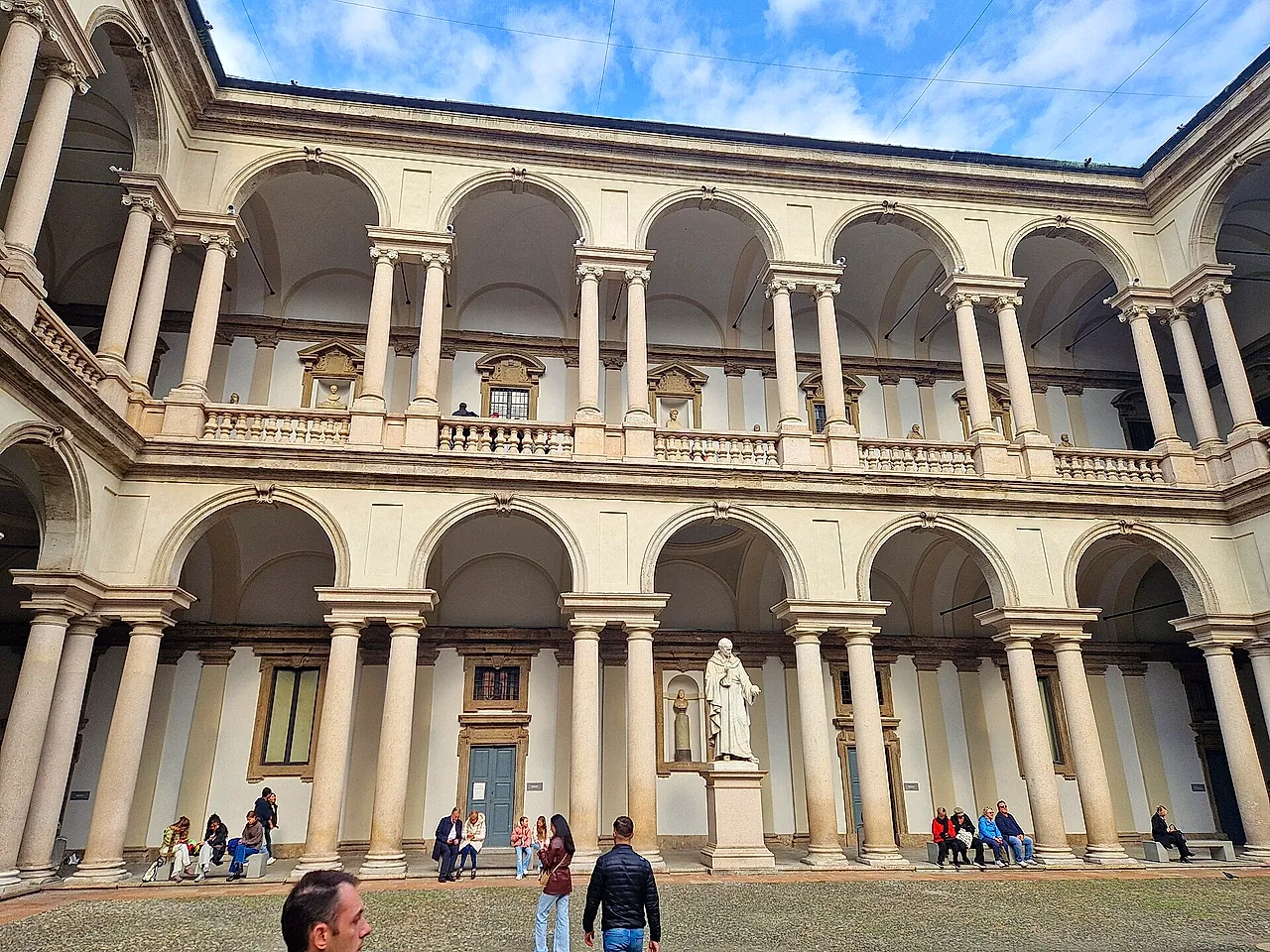
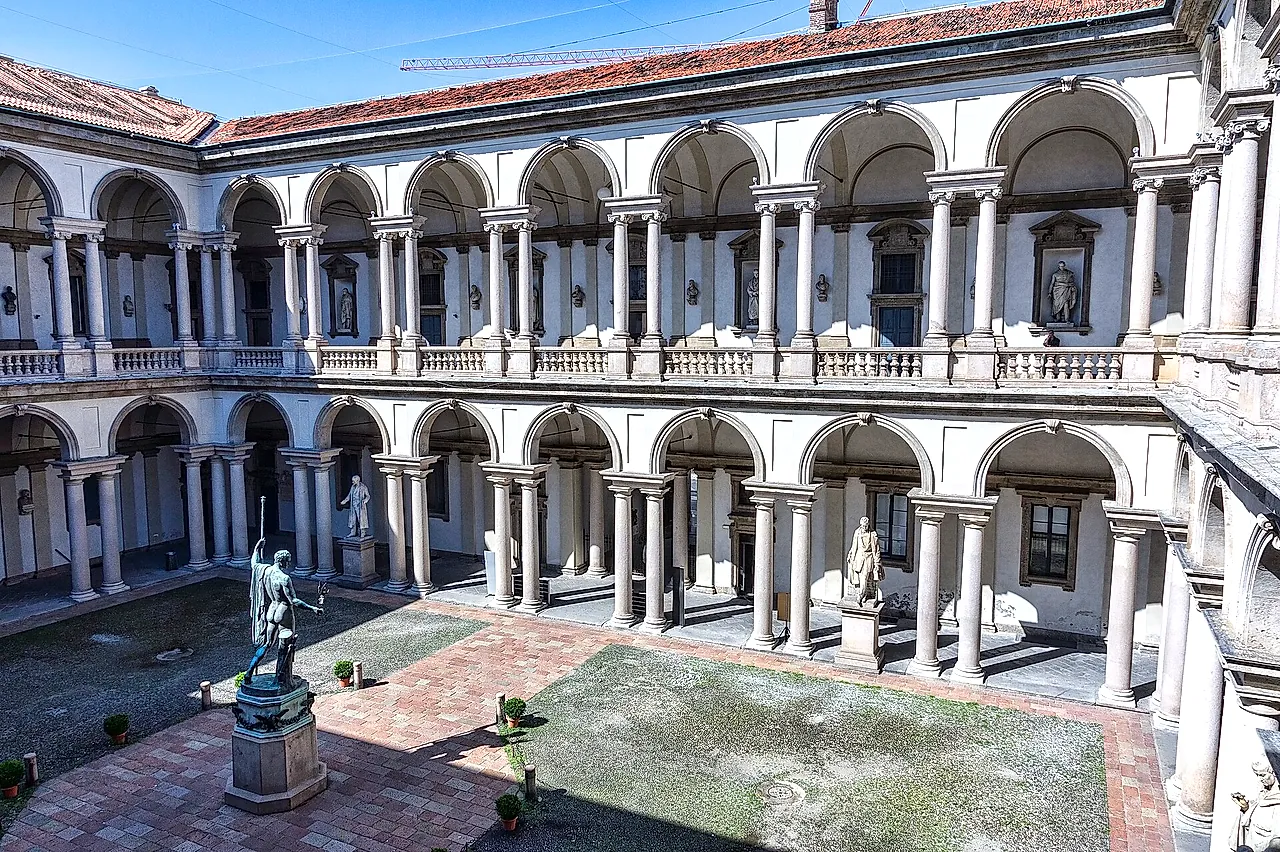
The museum says the palace rose on a 14th-century convent of the Umiliati order, then passed to the Jesuits, who ran a school there. The present building dates from the early 1600s, to a design by Francesco Maria Richini. In 1773, after the Jesuits were dissolved, the empress Maria Theresa made it a seat of cultural institutions: the Academy of Fine Arts, the Braidense Library, the Observatory and the Botanical Garden. Giuseppe Piermarini designed the portal on Via Brera and completed the courtyard.
The Pinacoteca was officially established in 1809, though a first teaching collection had stood beside the Academy since 1776. Under Napoleon, with Milan the capital of the Kingdom of Italy, it became a museum for the finest paintings of the conquered territories, and works taken from Lombard churches and convents after many orders were suppressed joined it. That is why large sacred paintings predominate. Baedeker’s 1903 handbook (p. 123) gives 1806 as the foundation date and a different date for the Jesuit building; we follow the museum.
Palazzo Citterio and the botanical garden
Palazzo Citterio, at Via Brera 12 and 14, opened to the public on 8 December 2024. The State acquired it in 1972; the project is by Mario Cucinella Architects, with an underground space by James Stirling. On the main floor the Jesi and Vitali collections hold more than 200 works, with Boccioni, Morandi, Modigliani, Picasso and Carrà, and room 40 shows Pellizza da Volpedo’s Fiumana.
The La Grande Brera ticket opens Palazzo Citterio for the day of the visit and the 6 following days. The Orto Botanico di Brera, created in 1774 under Maria Theresa, belongs to the University of Milan and is not included in the ticket; we could not confirm its hours.
Audio guides and guided visits
Two free audio guides for your phone, “5 Capolavori per te!” and “10 Capolavori per te!”, are listed on the museum’s site (IZI Travel). An audio guide can also be hired at the museum (Italian, English, French, German and Russian).
The Amici di Brera association runs guided visits on selected dates, in addition to the entry ticket. The museum lists the evening visit “Brera, amica mia!” on 22 and 29 October 2026 at 19:30; 22 October has passed.
Visitor guide
Milan Tours and Experiences: Bus, Bike, Boat and City Card
Seven Milan tours compared: two hop-on hop-off buses, two bike tours, a boat aperitif, an audio guide app and a city card, with what each includes.
Day Trips from Milan: Lake Como, Lugano, Bernina and Maggiore
Day trips from Milan compared: Lake Como, Lugano, the Bernina Red Train, Lake Maggiore boats and Villa del Balbianello: times, languages, inclusions.